NeuralTake: one engineer from the first call to the running system
The AI consultancy I founded in London in 2024. It automates manual workflows for professional services firms: a two-week audit, then fixed-fee builds that live in the client’s own repository. I sell, scope, build and support the work.
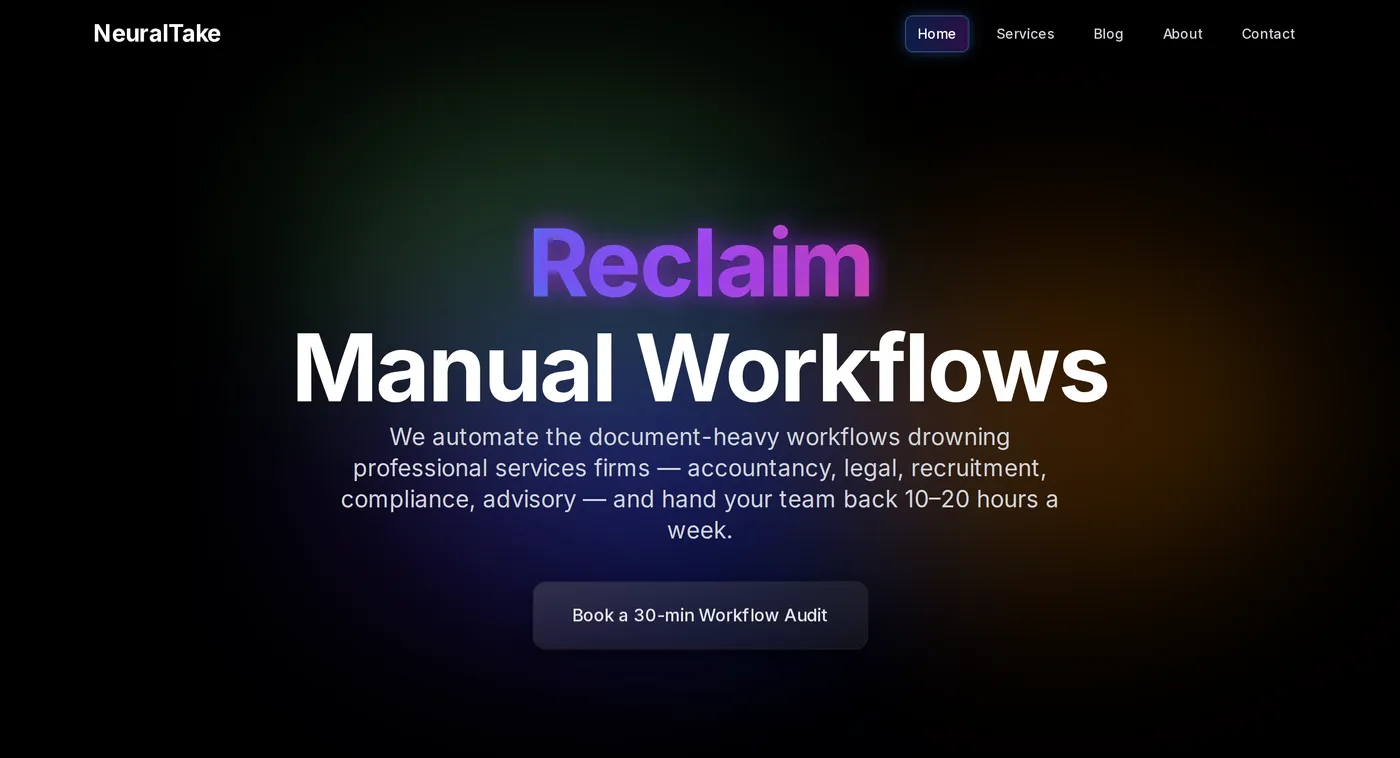
The problem
Professional services firms run on manual workflows: client onboarding, KYC, document review, CV screening, suitability reports, year-end packs. The firms NeuralTake works for are accountancy and legal practices, recruiters, compliance and advisory firms, financial advisers and insurance brokers. What they are usually offered is a platform to subscribe to. What they need is someone to watch how the work moves, and then replace the part that should not be done by hand.
NeuralTake (Neuraltake Limited) is my consultancy, founded in London in 2024. What it sells is a method and the engineering to carry it out. The method fits in one drawing.
From a thirty-minute call to a workflow the client owns
The method is the one published on neuraltake.com. I run every stage of it myself, so the person who scoped the work is the person who builds it and the person who answers when it misbehaves.
What I do
I own every stage in that drawing: stakeholder discovery, scoping, requirements, architecture, delivery, onboarding, support and the roadmap afterwards. Nothing is handed from a salesperson to an analyst to a developer, because they are the same person.
- I sell the work. NeuralTake has signed B2B contracts and delivered them end to end.
- I run the audit: two weeks beside the people doing the work, then a ranked list in writing that the firm keeps whether or not it goes further.
- I design and build the system in the client’s stack, in the client’s repository, on the client’s infrastructure. The site puts it bluntly: fire us tomorrow, nothing breaks.
- I train the people who will own it, write the runbooks, and cover defects for thirty days after launch.
Two pieces of work show what that produces. AI Zuzi is a client engagement: a social-media and content platform that I engineer for a client company, taken from an inherited prototype to a production system. NeuralKite is my own product: acquisition intelligence for UK private markets, with a mailbox verification engine written at socket level. Each has its own case study, with the engineering in detail.
Nine service lines
The public offer is nine lines. Two are advice, four are builds, two are data work, and one is the handover that makes the rest stick.
| Service line | Kind | What is delivered |
|---|---|---|
| Automation strategy consulting | Advice | Every workflow that eats staff hours is mapped, then ranked into a phased roadmap: what to automate first, second and third, and why. It includes the plain calls not to automate something. |
| Workflow audit | Advice | Two weeks embedded, shadowing the people who do the work. The result is a written, evidence-backed punch list, which the firm keeps whether or not it hires NeuralTake. |
| Fixed-fee pilot project | Build | One workflow, scoped, priced and shipped in four to six weeks. If it does not justify itself there is no second workflow, and the firm keeps what was built. |
| Process automation | Build | A whole workflow replaced end to end: client onboarding, KYC, document review, CV screening, suitability reports, year-end packs. Live in the client’s stack in two to six weeks. |
| Custom automation development | Build | Software built into the firm’s practice-management, CRM, document and email tooling. Fixed fee, fixed timeline, fixed scope. The code lives in the client’s repository and runs on the client’s cloud. |
| AI agents over your documents | Build | Retrieval-augmented agents over engagement letters, playbooks and prior advice, answering with citations and taking multi-step actions, from intake through conflicts and KYC to the engagement letter. They run inside the client’s data perimeter. |
| Forecasting and capacity analytics | Data | Operational forecasts a management team plans around: workload by quarter, utilisation, attrition risk and revenue per matter, built from calendar, billing and time-capture data the firm already holds. |
| Reporting and management information | Data | Work in progress, lock-up, realisation, utilisation, pipeline and win rate, pulled live from practice-management and CRM systems and delivered as dashboards, PDFs or scheduled digests. |
| Team training and adoption | Handover | Recorded training, plain-English runbooks and thirty days of post-launch defect cover, so the people who own the workflow can run, change and extend it. |
The engineering behind it
A small consultancy is only as good as what its founder can build and keep running. This is the stack I work in, with the place each part is in use.
| Area | What I work in | Where it is in use |
|---|---|---|
| Back ends | Python: Django 5, Django REST FrameworkTypeScript: Next.js App Router, Prisma | AI Zuzi is a Django REST API behind a React single-page app. NeuralKite is a Next.js application with streaming endpoints. |
| Front ends | React 18, Vite, Tailwind CSS, RadixNext.js, react-i18next | A single-page app in five languages for AI Zuzi; server-rendered React for NeuralKite and for neuraltake.com itself. |
| Models and agents | Anthropic SDK, OpenAI API, xAI APIretrieval, tool use, structured output | Claude agents that score, research and draft in NeuralKite. Text, vision, assistant threads, image and video generation in AI Zuzi. |
| Data | PostgreSQL, SQLite, Prisma, the Django ORMmigrations, ETL, sequence and key handling | A zero-data-loss live migration from SQLite to PostgreSQL on AI Zuzi. A self-hosted warehouse holding a 2.8-million-company Crunchbase load for NeuralKite. |
| Identity and payments | JWT, TOTP and email one-time codes, NextAuthStripe Checkout, webhooks, invoices, billing | Multi-factor sign-in and a token economy on AI Zuzi; subscription billing on NeuralKite. |
| Integrations | Meta Graph, Instagram, YouTube, TikTok, LinkedIn, Pinterest, Threads, Google Business Profile, WordPressCompanies House, SMTP and DNS at socket level | OAuth connections and publishing services in AI Zuzi. Registry data and a mailbox verification engine in NeuralKite. |
| Security | Field encryption at restSSRF guards, rate limits, CSP, log redaction | Stored OAuth tokens in AI Zuzi and stored SMTP passwords in NeuralKite are encrypted before they reach the database. GDPR-aligned deletion with a thirty-day purge on AI Zuzi. |
| Quality | pytest, GitHub Actions, Sentrystructured audit logging | AI Zuzi deploys from main only when its automated tests and its front-end build pass. |
The infrastructure I run
I operate the servers as well as writing the software that runs on them.
| Layer | What I run | What it is for |
|---|---|---|
| Servers | A fleet of Ubuntu VPS machinesDocker, Google Cloud Run | Long-running applications, databases and mail sit on the VPS fleet; containerised services go to Cloud Run. |
| Web | nginx, Let’s EncryptApache with mod_wsgi where a client already runs it | Reverse proxying, static sites and TLS certificates. This site is served by the same nginx. |
| Processes | pm2 for Node applicationscron for scheduled jobs | Restarts on failure, logs, and scheduled jobs such as database backups. |
| Databases | Self-hosted PostgreSQL | Application databases and the Crunchbase warehouse, with dumps taken from the live server. |
| A self-hosted Postal mail server | Transactional and outreach sending with delivery, open, click and bounce events returned by webhook. |
Decisions that mattered
- Sell the audit before the build
- The first paid step is two weeks of watching the work. It produces a ranked list the client owns, and the build that follows is scoped from observation, not from a description of a process given by someone who no longer does it.
- Fixed fee, fixed scope, fixed timeline
- Scope, price and date are agreed before week one. That puts the risk of the estimate on me, where it belongs, and it forces the scope down to one workflow at a time.
- The client owns the code
- Everything is built in the client’s repository and deployed on their infrastructure. There is no NeuralTake platform to subscribe to, so nothing stops working if the relationship ends.
- Say no in writing
- The audit is expected to say which workflows should not be automated. Some problems are a process change, and a punch list that admits it is worth more than one that does not.
- One owner from discovery to support
- The person who scopes the work also builds it and answers for it afterwards. Requirements do not get lost between roles, and the architecture is chosen by someone who will have to support it.
- Run my own infrastructure
- Operating servers, databases and a mail server myself is how I know what a deployment costs to keep alive, and it is why the systems I hand over come with runbooks.
Evidence that it works
- Signed
- B2B contracts, delivered end to endAI software and consultancy work sold, scoped, built and supported under contract through NeuralTake. Stated September 2026. Clients and values are not published.
- In production
- a client platformAI Zuzi, engineered for a client company through NeuralTake and live at socials.aizuzi.com. Its figures are on its own page.
- Live
- a product of my ownNeuralKite, publicly accessible at neuralkite.com, checked 15 September 2026. Customer and usage figures are not published.
The consultancy’s own site, neuraltake.com, was live when checked on 15 September 2026. The strongest evidence for the engineering is in the two linked case studies, where the code is described in detail.
Limitations and status
NeuralTake is a small consultancy. I do not name clients, I do not publish contract values or revenue, and I do not give a client count. The hours-saved figures on neuraltake.com describe what the method aims at; this page does not repeat them as results, because I have not published measurements from client engagements. The business is active.
What I learned
Discovery decides whether software gets used. Architecture decides whether it can be supported.
Most of what goes wrong in client software goes wrong before any code is written, in a scope that nobody watched the work to produce. Most of what goes wrong afterwards is a system nobody on the client’s side can run. Doing every stage myself has made me a more careful engineer: I write the runbook knowing I may be the one reading it at a bad moment.
Where to look
neuraltake.com (opens in a new tab) is the consultancy’s public site. The engineering is in the AI Zuzi case study and the NeuralKite case study. Client work beyond what those pages describe is confidential and is not shown.